PRIVATE PARAMEDICAL PRACTICE
Confidential enquiries
PLATE 04 · POST-MASTECTOMY
Areola tattooing after mastectomy, planned at your pace.
Restorative pigment work for chests changed by mastectomy, with or without reconstruction. Shape, placement and tone are drawn and agreed before any pigment is used, and readiness is decided with your treating team rather than by us.
Skin-safe marker, tracing paper, a measured stencil — the design stage comes first.

Plate ii — Reference photograph: sterile instrument preparation in a clinical setting.
BEFORE YOU ENQUIRE
A short checklist to bring to the conversation
None of this is required to make contact. It simply helps the first conversation be useful rather than general.
- What your surgeon, breast care nurse or GP has said about timing.
- Whether radiotherapy formed part of your treatment, and roughly when it finished.
- How settled the area feels — whether skin and scar tissue still seem to be changing.
- Whether you are considering one side or both.
- Any earlier tattooing, pigment or camouflage work in the same area.
- What matters most to you: colour, symmetry, softening a scar line, or simply understanding the options.
OVERVIEW
What the treatment involves
Post-mastectomy areola tattooing uses cosmetic pigment to rebuild the appearance of areola colour and definition on skin where the nipple and areola have been removed. Depending on what you would like, the work may be flat colour, or it may use graduated tone to suggest depth — the approach described on our 3D Areola Tattoo page.
The mastectomy chest presents its own considerations. Scar lines may run through or near the area being designed; skin texture and pigment response can differ across the chest; and where surgery was on one side only, the design is drawn in relation to the other side rather than to a template.
Readiness is personal, and it is not something a tattoo studio can determine. Your surgeon or treating team is the right source of advice on how long to wait after surgery or radiotherapy and whether the skin is suitable. We work alongside that advice, not ahead of it, and will happily wait while you check.
WHO IT MAY SUIT
People this work is often considered by
Those who have had a single or double mastectomy and would like the appearance of areola colour returned, whether reconstruction followed or the chest remains flat.
Those who have had nipple reconstruction surgery and want colour and definition added to it, which is covered further on our Breast Reconstruction Tattooing page.
Those whose main concern is a scar line rather than colour, where Areola Scar Camouflage may be discussed instead of, or alongside, restorative colour work.
THE CONSULTATION
Scar position, skin texture and how the design is decided
Consultation is a conversation before it is an appointment. We look at the area unhurried and in private, talk through where scars sit, how the skin has healed, and what you would like the finished area to read as from a normal viewing distance.
Placement is then drawn on the skin with a skin-safe marker and checked standing, seated and in a mirror, because symmetry on paper and symmetry as you see it are not always the same thing. Colour is discussed against your own skin tone; the guide to areola colour selection explains how that choice is approached.
Outcomes are not predicted. Pigment settles differently on scarred, grafted and radiated skin, and how much softens during healing varies between people and even between sides. What we can describe is the process, the design, and how the result will be reviewed once healed.
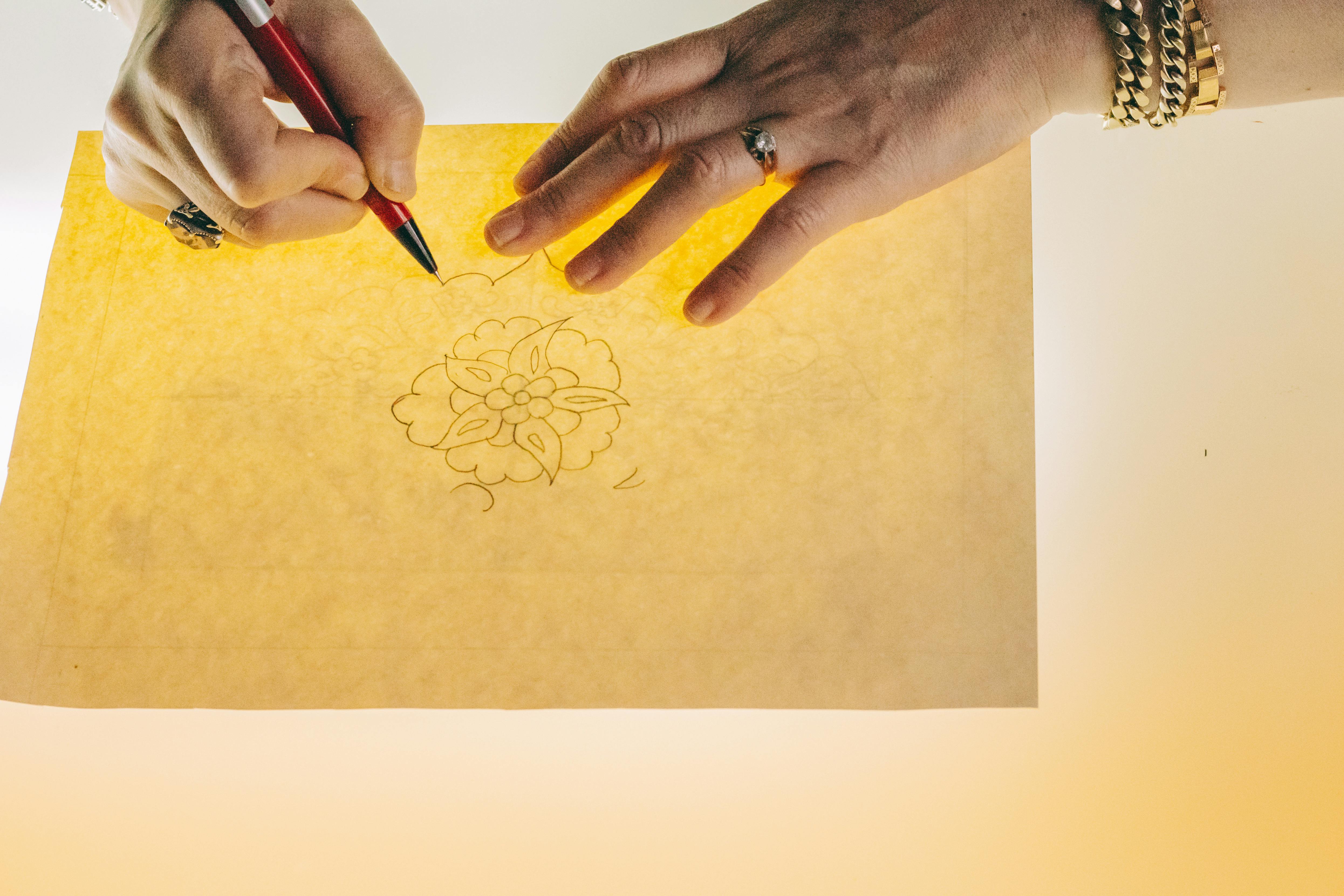
Plate iii — Reference photograph: a design drawn and refined on paper, the stage that comes before any pigment.
01
Preparation
Confirm timing with your treating team first. On the day, come in comfortable clothing that opens at the front, eat beforehand, and allow the visit not to be rushed. You are welcome to bring someone with you.
02
The appointment
The agreed design is mapped and confirmed with you before work begins. Pigment is then built in light passes, checked as it goes. Sensation across mastectomy skin is often reduced, though this differs from person to person.
03
Healing
Colour usually looks stronger at first and softens as the skin settles. Written aftercare is given to you at the appointment and takes precedence over anything read online; our healing guide covers the general picture.
04
Review
Once healed, the area is reviewed together. Scarred skin sometimes holds pigment unevenly, so a second session to adjust depth or tone is a normal part of this work rather than a sign something went wrong.
QUESTIONS
Questions we are asked most often
How long after surgery can this be done?
That answer belongs to your surgeon or treating team, who know your healing and any ongoing treatment. Once they are comfortable, we can begin. There is no advantage in hurrying the design stage.
What if a scar runs through the areola area?
It is common, and it is part of the design conversation rather than an obstacle to it. Scar tissue can take pigment differently from surrounding skin, so placement, tone and the number of sessions are considered with that in mind.
Can one side be treated rather than both?
Yes. Single-side work is designed in relation to your existing areola — its width, edge softness and tone — and is usually approached conservatively, building colour gradually rather than matching in one pass.
How private is the studio?
Appointments are one-to-one and unobserved, and nothing is photographed or shown anywhere without your written agreement. The Before & After gallery contains approved results only.
When your surgical team says the skin is ready, we can plan at your pace.
An enquiry is not a commitment to treatment. Tell us where you are in your recovery and what you would like to understand, and we will reply with information rather than pressure. Enquiries reach the studio privately.
CONTINUE READING
Breast Reconstruction Tattooing — when tattooing follows reconstructive surgery.
3D Areola Tattoo — how graduated tone suggests projection.
Areola Scar Camouflage — softening the look of scarring in the area.
Guide: Areola Tattoo After Mastectomy — timing, questions and what to expect.