PRIVATE PARAMEDICAL PRACTICE
Confidential enquiries
REFERENCE · QUESTIONS
Home / Frequently Asked Questions
Questions asked before, during and after areola tattooing.
The full question set, grouped in the order things actually happen — what to weigh up before enquiring, what a consultation covers, what the appointment involves, how colour and shape are decided, how healing is looked after, and what happens in the years afterwards.
Answers are kept plain. None of them predict how a particular person’s skin will respond, and none of them stand in for advice from your own treating team.
ON THIS PLATE
01 Before you enquire
02 The consultation
03 The appointment
04 Colour and design
05 Healing and aftercare
06 Afterwards
PREPARATION

Reference photograph: instruments set out before work begins. Several of the questions below are about preparation and hygiene — both are walked through in person, in the room you will be treated in.
01 · REFERRALS, PRIVACY, FIRST CONTACT
Before you enquire
Who does the studio see?
People considering areola tattooing after mastectomy or reconstruction, people whose existing areola work has softened or shifted in tone, and people asking about camouflage tattooing over scarring. If you are unsure which treatment your question belongs to, the Services hub sets all ten side by side, from Areola Tattooing through to Scar Camouflage.
Do I need a referral?
No referral is needed to ask a question. Where treatment would follow surgery, the timing is a matter for the surgeon or breast care team who have followed your recovery. Their view on readiness is what a consultation works from — it is not something a studio can decide for you. The Post-Mastectomy Areola Tattoo page explains where that line sits.
How private is the studio?
Consultations are held one to one. Enquiries are read by the studio and nobody else, and nothing you write or send is published. Images only appear in the Before & After gallery where a client has specifically agreed to it, and consent can be withdrawn.
I am only gathering information. Is that alright?
Yes. Enquiries often arrive long before anything is arranged, sometimes while surgery is still underway. The Resources & Guides section is written for exactly that stage, and making contact commits you to nothing.
02 · WHAT IS DISCUSSED, AND WHEN
The consultation
What is actually discussed?
What you would like the area to look like; the condition, texture and colour of the skin as it is now; how shape and placement might be mapped; and what tattooing can reasonably work with. It is a conversation about method and suitability rather than a sales appointment.
Are photographs needed?
Not to make contact. Where an image would genuinely help, it is discussed once you are already in touch, and most people prefer the area to be looked at in person instead. Nothing is requested before you are comfortable with it.
Will I have to decide anything on the day?
No. People frequently take the information home, raise it with their surgeon or their family, and return weeks or months later. A consultation is there to give you enough to make a decision calmly, in your own time.
Can I bring someone with me?
Yes. A partner, friend or family member is welcome, and a second set of ears is often useful for the practical detail.
03 · STENCIL, COMFORT, STAGES
The appointment
Nothing on the day happens without your agreement first.
Will I see the design before anything is tattooed?
Yes. Shape and placement are drawn on the skin first with a skin-safe marker, then checked with you seated and standing, in a mirror, with time to look properly. Work only begins once the stencil is one you have approved.
What if I change my mind partway through?
Then it stops. You can pause or end an appointment at any point, and saying so is treated as an ordinary part of the process rather than an inconvenience.
Will it be uncomfortable?
Sensation varies considerably between people, and surgery often changes feeling in the area in ways that are difficult to predict. Rather than assume, comfort is discussed in advance at consultation, and checked again during the appointment itself.
Is everything finished in one sitting?
Restorative areola work is generally approached in stages, with the skin given time to settle before anything is judged. Whether any further work is wanted is decided with you after healing — not scheduled in advance on your behalf. The 3D Areola Tattoo page describes how shading is built up this way.
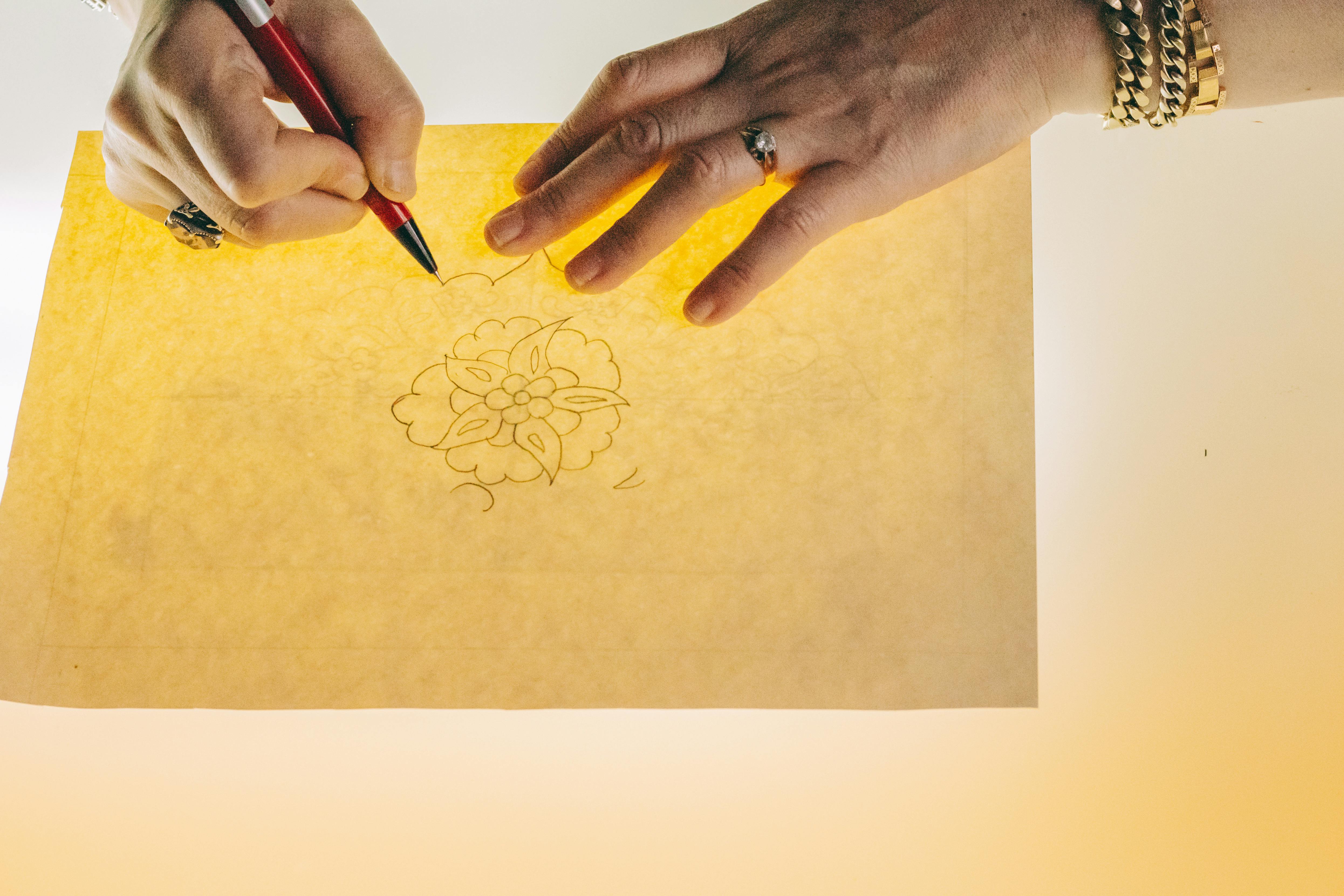
Reference photograph: a design worked out on paper before anything is placed on skin. Shape is drawn and agreed first, and tone is read from your own undertone in daylight rather than from a swatch alone.
04 · UNDERTONE, SYMMETRY, LIMITS
Colour and design
How is colour chosen?
In daylight, against your own skin, working from undertone and from whatever reference exists — the other side, an older photograph, or your own description. Fresh pigment and healed pigment read differently, and the choice allows for that. The Areola Colour Selection guide sets out the reasoning in full.
Can two sides be made to match exactly?
Symmetry is mapped and measured carefully, but skin that has been operated on does not behave identically on both sides. The intention is a considered, natural-looking result rather than a mirror image, and that distinction is made plainly before anything begins.
Why is no result promised?
Because pigment sits in living skin, and skin that has been through surgery, radiotherapy or grafting responds in its own way. What can honestly be described is the method — how tone is selected, how shape is mapped, how the work is reviewed. Anything beyond that would be guesswork dressed up as a guarantee.
What about earlier work that now looks warm or uneven?
It is assessed on its own terms, including whether adjustment is advisable at all. See Areola Colour Correction, or Areola Scar Camouflage where scarring is the dominant feature.
05 · THE FIRST WEEKS, AND WHO TO CALL
Healing and aftercare
What does aftercare involve, in general terms?
Keeping the area clean and protected, following the written instructions given to you at the appointment, and otherwise leaving the skin alone while it recovers. General guidance is set out in the Areola Tattoo Healing guide — your own instructions always take precedence over anything published here.
When does the colour look settled?
Pigment looks strongest on the day it is placed and softens as the skin recovers. Colour cannot be judged fairly until that settling has run its course, which is why a review is arranged after healing rather than during it.
When should I contact a doctor rather than the studio?
If you notice increasing pain, spreading redness, heat, swelling, discharge or a fever, contact your GP or treating team. A studio cannot assess or diagnose a medical problem, and signs like those belong with a clinician straight away.
06 · MONTHS AND YEARS LATER
Afterwards
Areola work is not finished the moment you leave the room. Four things come up regularly once healing is behind you.
The review
Once the skin has settled, the work is looked at again in daylight — tone, softness of edge, how the two sides read together — and any adjustment is discussed then, with you, rather than assumed in advance.
A refresh, later on
Pigment is placed lightly in the upper skin, so it softens over years. When to Consider an Areola Tattoo Refresh describes the changes people notice first; the Areola Tattoo Refresh page covers what that appointment reviews.
Older work from elsewhere
Colour that has drifted warm, edges that have spread, or shapes that no longer sit well are assessed individually — sometimes as colour correction, sometimes within broader paramedical tattooing, and sometimes with a recommendation to leave well alone.
Seeing what the work looks like
The Before & After gallery holds approved client results only, presented discreetly, with each entry pointing back to the treatment it belongs to.
CONSULTATION
If your question is not here, it is worth asking in private.
A confidential enquiry is the right place for anything specific to your own history, your surgery or your skin — the questions a general page cannot answer honestly.
Enquiries are read by the studio and handled confidentially. Nothing you write is published, and you are never asked for more detail than you want to give.