PRIVATE PARAMEDICAL PRACTICE
Confidential enquiries
Plate 02
3D areola tattoo: depth drawn in light and shadow
Dimensional areola tattooing builds the impression of projection out of graduated tone — a highlight, a body of mid-colour, a soft shadow. The effect is visual rather than physical. Nothing is raised; what changes is how the area reads to the eye.

Reference photograph: pencil drawing on white paper — the design stage that comes before any stencil, and long before pigment.
Discipline
How flat skin is made to read as dimensional
Dimensional work is a drawing problem before it is a tattooing one. Where the chest is flat, the impression of a raised nipple has to be constructed entirely from tone: a small highlight placed where light would fall, a mid-tone across the body of the shape, and a softer shadow beneath and to one side. The eye reads that gradient as form. The same principles apply whether a shape is designed to sit alongside an existing areola on the opposite side, or drawn for both sides together. This is the technique described in more detail in the guide What Is 3D Areola Tattooing?, and it sits within the wider practice of Areola Tattooing.
Plate 02·b
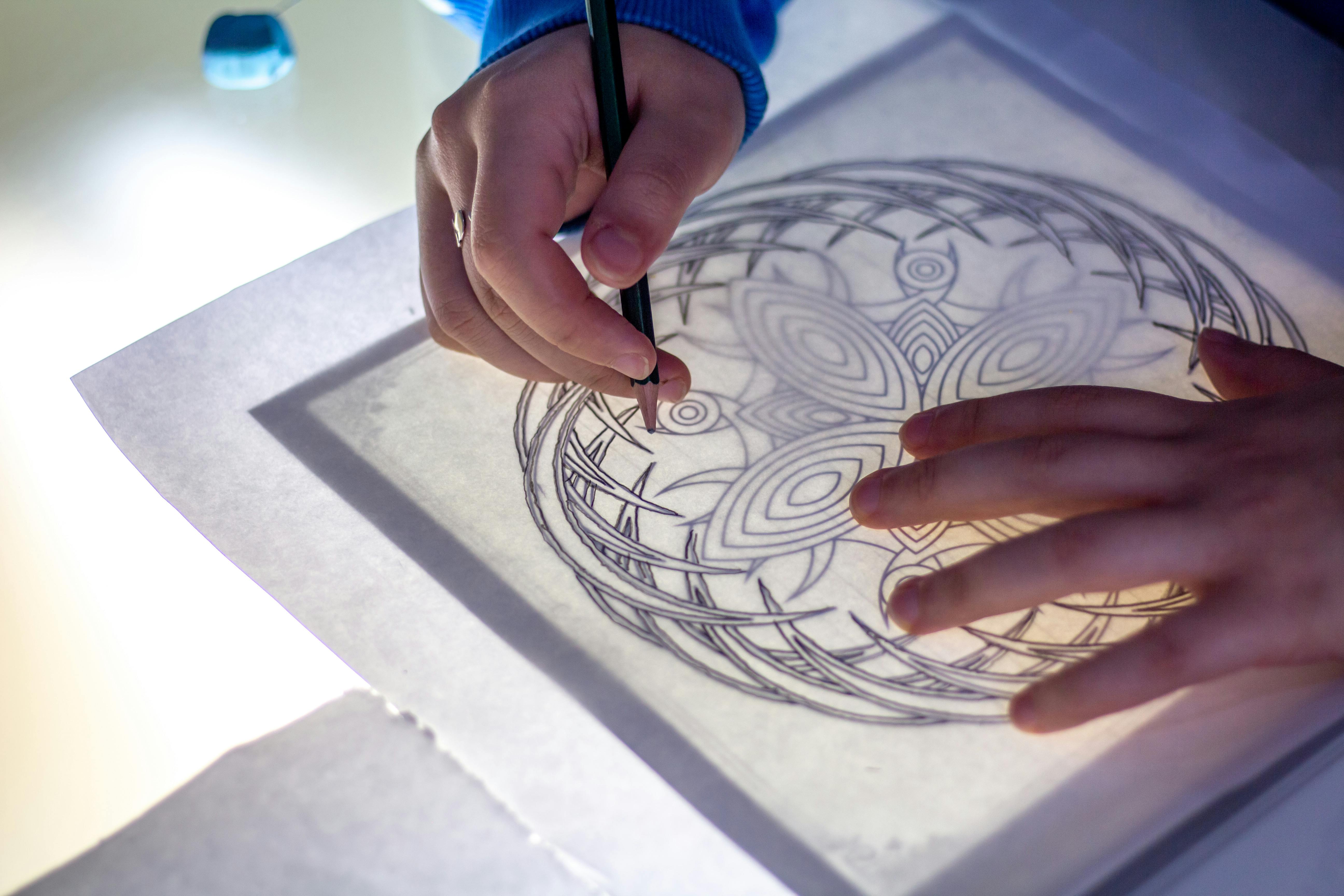
Reference photograph: a circular, symmetrical design worked out on paper. Dimensional areola work begins the same way — diameter, edge and balance drawn and checked against the opposite side before any shading is considered.
Suitability
Who this may suit
After reconstruction, where no nipple tissue remains
This is the most common reason people ask about dimensional work. Where the chest has been reconstructed and the surface is flat, shading is the only way to suggest contour. Related considerations are set out on Breast Reconstruction Tattooing.
Where one side is being matched to the other
When an areola remains on one side, the drawing stage is largely a matter of measurement — diameter, height on the chest and the direction light falls — so the new shape sits in agreement with the existing one rather than competing with it.
Where earlier flat tattooing has softened
Some people come with existing areola tattooing that has lost contrast over time and want to know whether shading can be reworked. That is assessed in person rather than from description alone; see Areola Tattoo Refresh.
Sequence
From the first drawing to settled colour
Four stages, each with a point at which you can pause, ask questions or decide not to continue.
01
Consultation and drawing
Shape, diameter, placement, symmetry against the opposite side and tone are drawn and reviewed together. Nothing is decided in a single sitting.
02
Preparation
Timing and skin condition are discussed beforehand. Where surgery has been involved, clearance from your treating team guides when work can begin.
03
The appointment
A stencil is placed and checked seated and standing, in a mirror, and approved by you before any pigment is applied. Shading is then built in graduated passes.
04
Healing and review
Contrast looks strongest at first and softens as skin settles. Aftercare is given in person, and a later review considers whether a second pass would be useful. See Areola Tattoo Healing.
Questions
Asked most often about dimensional work
How dimensional does it actually look?
That depends on skin tone, surface texture, scarring and how the shading settles, which is why it is assessed in person. What can be said in general is that the illusion is built from contrast, so the more evenly the skin holds pigment, the more clearly the gradient reads.
Does it look the same from every angle?
No, and it is better to know that beforehand. Shading is designed around a single light direction, so it reads most convincingly viewed straight on. From a sharp side angle the absence of physical projection is more apparent. This is explained plainly at consultation.
Will it need refreshing later?
Pigment softens gradually in all cosmetic tattooing, and contrast is what carries a dimensional effect. Many people revisit the work at some point; whether and when is an individual judgement discussed at a review rather than scheduled in advance.
Can one side be treated on its own?
Yes. Single-side work is common and the design stage focuses on matching size, position and tone to the existing areola. Further questions are collected on the Frequently Asked Questions page.
Related
Where to read next
Areola Tattooing
The foundational treatment: shape, colour design and placement explained from the beginning.
The foundational treatment: shape, colour design and placement explained from the beginning.
Breast Reconstruction Tattooing
How reconstructed tissue and surgical scarring influence design, tone and timing.
How reconstructed tissue and surgical scarring influence design, tone and timing.
What Is 3D Areola Tattooing?
A longer guide to shading, light direction and what the technique can and cannot do.
A longer guide to shading, light direction and what the technique can and cannot do.
Before & After
Approved client results, presented discreetly, with links back to the relevant service.
Approved client results, presented discreetly, with links back to the relevant service.
Consultation
See how the shading reads from the angle you actually stand at.
Enquiries about dimensional areola work are read privately by the studio and discussed only with you. Send a note through the confidential form and we can talk through whether a consultation is a sensible next step.